The Reformer uses a moving carriage, springs, straps and a footbar to support, resist and challenge whole-body movement.
Reformer Pilates is not simply Mat Pilates transferred onto a machine. The equipment changes the movement experience and creates different opportunities for strength, control, balance and coordination.
A Reformer is a specialist piece of Pilates apparatus originally developed by Joseph Pilates. It has a padded platform called a carriage, which moves along rails inside a frame.
The carriage is connected to adjustable springs. Ropes and straps allow the hands or feet to move the carriage, while the footbar and shoulder rests provide support in different positions.
The simplest explanation: a Reformer is a spring-based movement system that can make an exercise more supported, more resisted or more challenging to control.
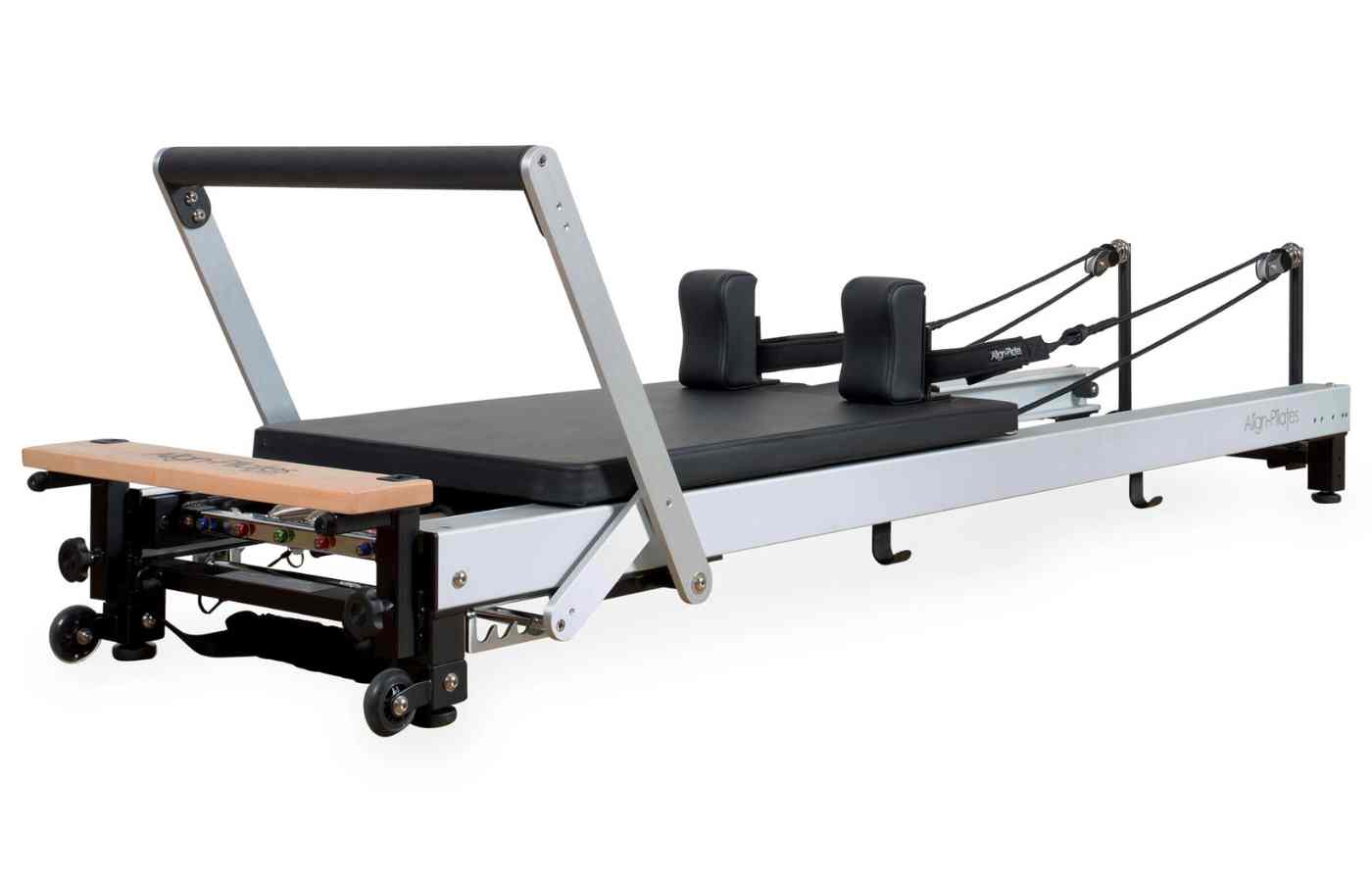
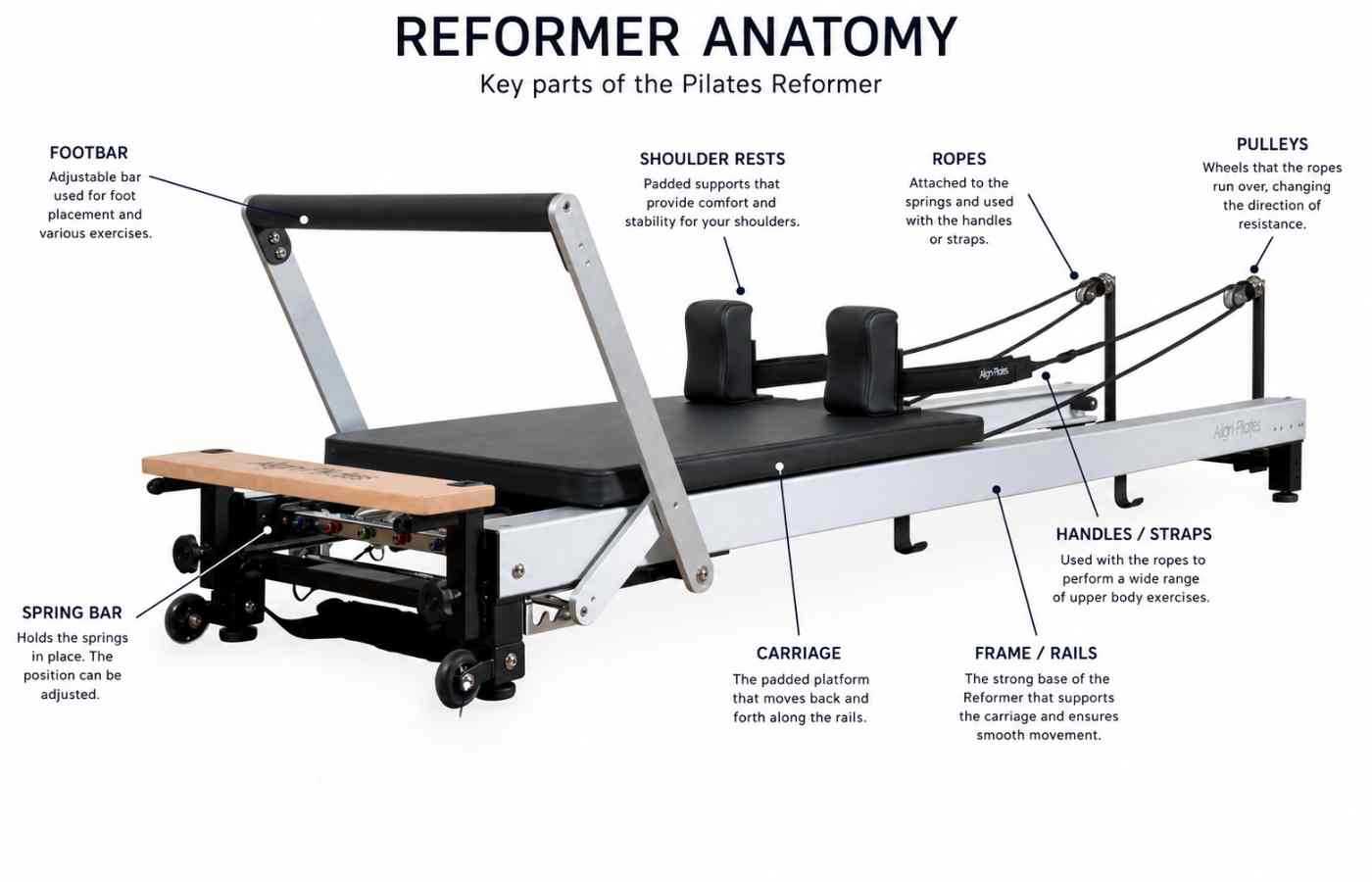
Reformers vary slightly between manufacturers, but the main parts serve similar purposes.
The padded platform moves along the frame. Controlling its movement is central to many Reformer exercises.
Springs provide adjustable resistance and assistance. More springs do not always make an exercise harder.
The hands or feet can work against the springs through the ropes, allowing movement in many directions.
The footbar provides a surface to push against and can be adjusted for different exercises and body positions.
These help position the body and provide feedback when lying, kneeling or sitting on the carriage.
These provide support and additional surfaces for standing, kneeling and transitional exercises.
The springs are one of the most important features of the Reformer. They create resistance that changes as the spring lengthens or shortens.
This means a spring can challenge a movement, support it or give the body useful feedback about direction and control.
Pushing or pulling against the spring develops strength and control.
The spring may help someone return from a movement or provide support while learning an exercise.
Unlike a fixed weight, the spring often becomes more demanding as it lengthens.
A heavier setting may create more support in one exercise but greater resistance in another.
More springs do not always mean a harder exercise. The body position, direction of movement and purpose of the exercise all matter.
Sometimes it can feel more supported. At other times, the moving carriage and spring resistance make the exercise more demanding.
Neither Mat nor Reformer is automatically the easier or more advanced form of Pilates. The exercise and the way it is taught matter more than the equipment.
The springs can challenge the legs, hips, trunk, back, shoulders and arms.
The carriage must be moved and returned without allowing the springs to take over.
Many exercises combine the movement of the carriage, limbs, straps and breathing.
Kneeling and standing exercises challenge stability on a moving surface.
The machine allows controlled movement through different ranges and positions.
The springs and carriage provide immediate feedback about alignment and effort.
Reformer Pilates is generally whole-body exercise rather than a system designed to isolate one muscle at a time.
A single exercise may involve the legs pushing the carriage, the trunk controlling the position, the back supporting the spine and the arms managing the straps.
It is more accurate to ask what movement pattern an exercise develops than which single muscle it works.
Many gym machines guide the body through one fixed path and focus on a specific muscle group. A Reformer can be used in hundreds of positions and directions.
The carriage moves, the spring tension can change and the body may be lying, sitting, kneeling or standing. This often requires more coordination and whole-body organisation.
The Reformer is not simply a resistance machine. It is a teaching tool that gives feedback about how you move.
Yes. The Reformer can be very suitable for beginners when the class is taught at the right pace.
Beginner classes allow time to learn how to enter and leave the machine safely, change springs, use the straps and understand how the carriage responds.

Classes vary between teachers and levels, but most include several different body positions and movement patterns.
The class often begins with footwork, breathing or simple movements to prepare the body and introduce the spring setting.
The session may include leg work, straps, kneeling, seated, standing and upper-body exercises.
The final exercises may reduce the pace and include mobility, stretching or controlled integration work.
You will not necessarily perform every exercise in every class. Variety is one of the main strengths of the Reformer.
The springs provide resistance or assistance, but you still have to control the carriage and organise the movement.
Some exercises are more supported; others are more demanding because of the moving carriage and springs.
Strength, balance, mobility and coordination are useful regardless of gender.
No. Exercises can be adapted to the range you currently have.
Reformer exercises can be performed lying, seated, kneeling, standing and in weight-bearing positions.
The equipment can support people returning from injury, but it can also provide highly challenging strength and conditioning work.
People often enjoy Reformer Pilates if they:
The best way to decide is not by looking at the machine. It is by choosing a class and teaching level that suit your experience and needs.
Our beginner-friendly classes give you time to learn the machine, understand the springs and build confidence gradually.

