Pilates equipment can support, resist, guide and challenge movement. Each piece offers a different way to explore strength, control, balance and mobility.
Pilates equipment is not a collection of machines designed simply to make exercises harder. Each piece changes the movement experience and gives the instructor another way to teach the method.
Joseph Pilates developed apparatus to help people understand movement through resistance, support and feedback. A spring may challenge one exercise while assisting another. A pedal may build strength but also reveal balance differences. A small ball may support the body or make a familiar exercise less stable.
The equipment does not replace the Pilates principles. It gives you another way to practise them.
The simplest explanation: Pilates equipment changes how a movement feels so the body can learn strength, control, coordination and balance in different ways.
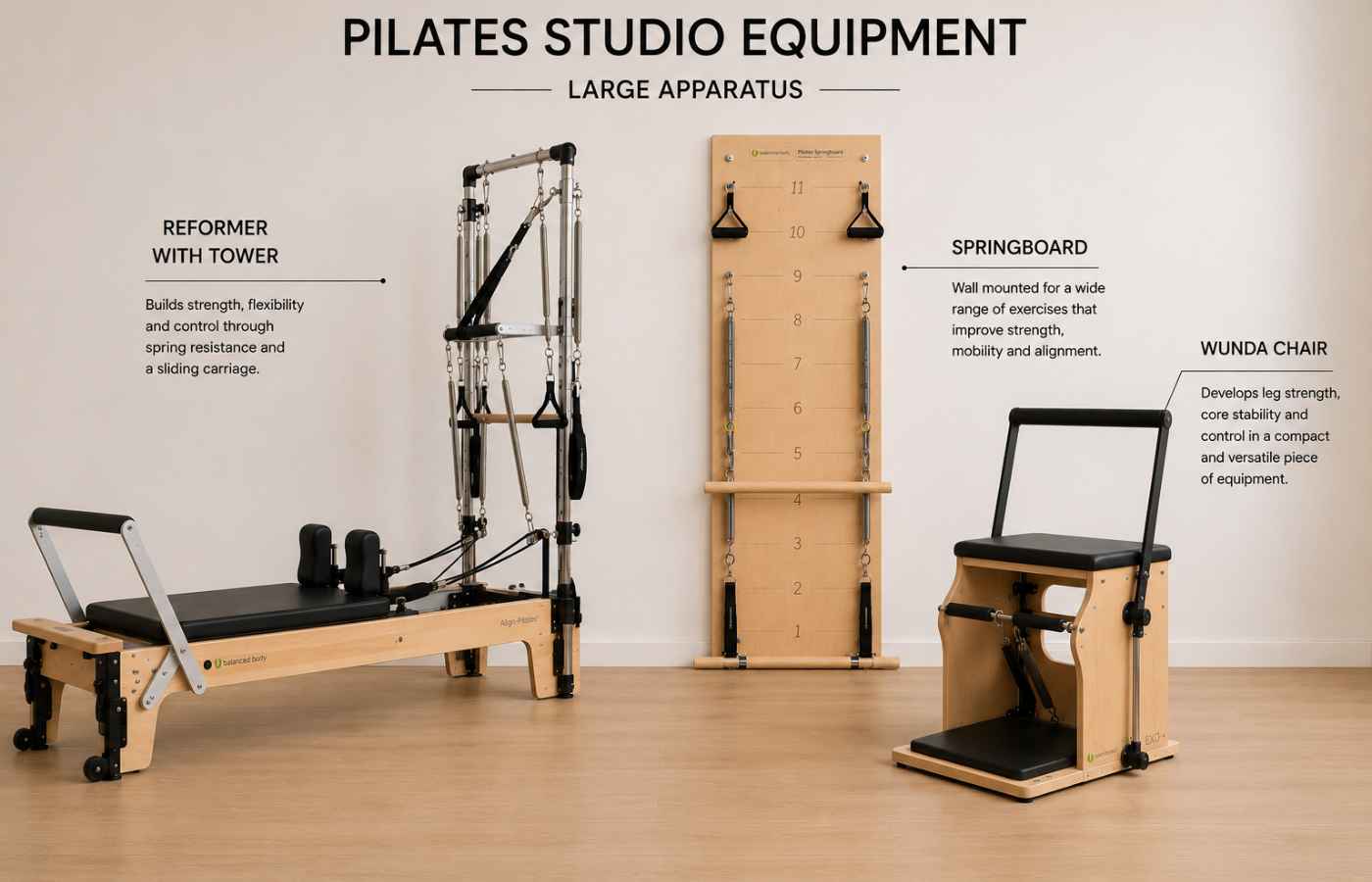
The larger apparatus uses springs, pedals, moving platforms or fixed bars to create resistance and support. Each piece feels different, but the same movement principles run through all of them.
The Reformer has a carriage that slides along a frame, connected to adjustable springs. It allows exercises to be performed lying, sitting, kneeling and standing.
It can support movement, create resistance and provide immediate feedback about control and symmetry.
The Tower and Springboard use springs attached to a vertical frame or wall. The springs can be pulled from different heights and angles, creating opportunities for standing, seated and lying exercises.
They are useful for upper-body strength, spinal movement, posture, balance and controlled resistance.
The Chair uses a spring-loaded pedal rather than a moving carriage. Exercises may be performed sitting, standing, kneeling or supported through the hands.
It is particularly effective for strength, balance, single-leg control and whole-body coordination.
The Reformer, Tower, Springboard and Chair do not teach separate methods. They explore the same Pilates principles through different positions, spring directions and stability demands.
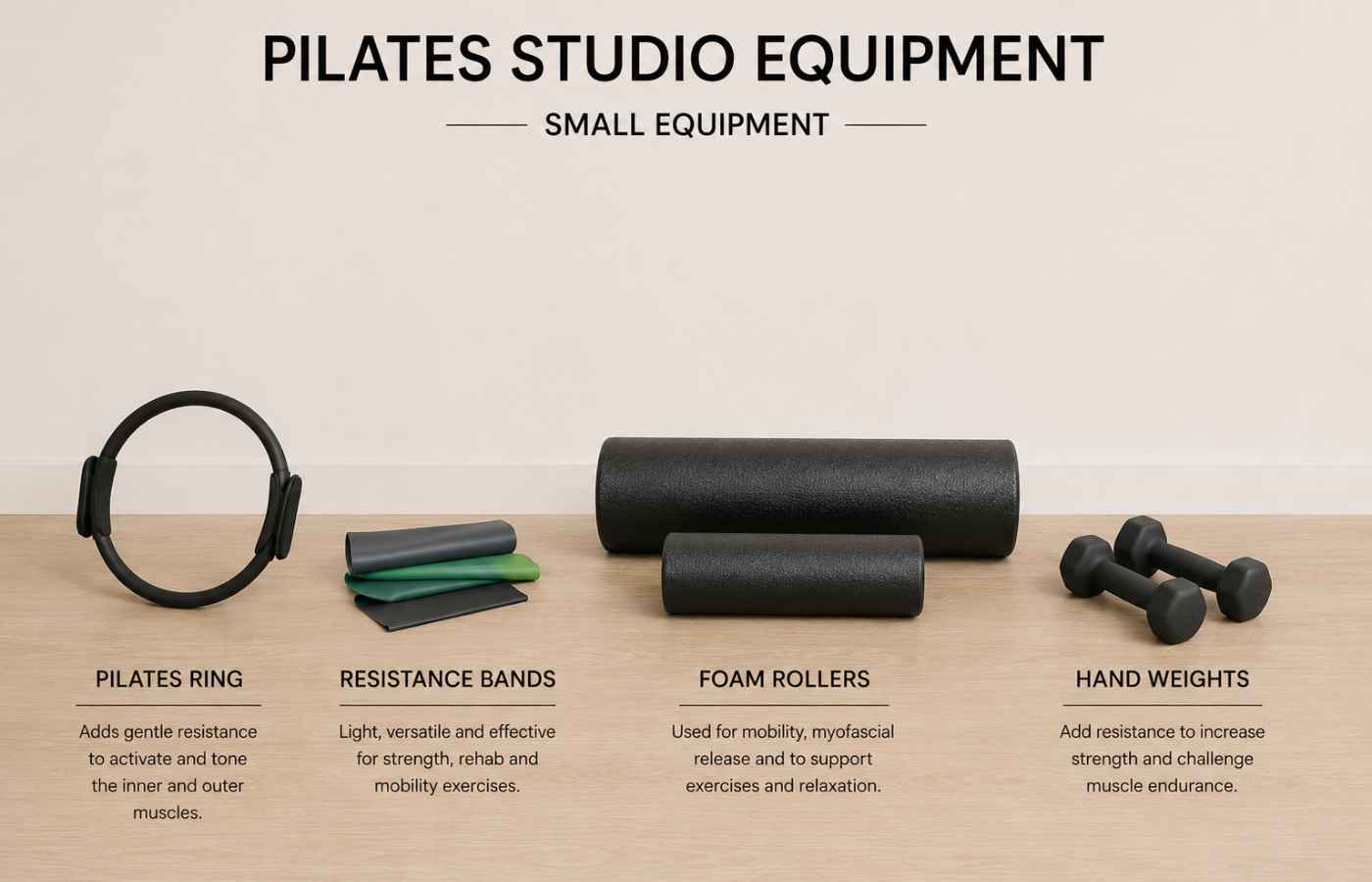
Small equipment is usually used to change how an exercise feels rather than create an entirely new exercise. It may add resistance, offer support, improve feedback or challenge balance.
Provides resistance and feedback for the arms, legs and trunk.
Can resist a movement, assist it or help guide direction and alignment.
May provide support, instability, balance challenge, mobility or body awareness.
Add upper-body strength and coordination without changing the Pilates focus on control.
Equipment gives instructors more teaching options, but it does not automatically create a better class.
An excellent mat class may use only body weight and a mat. A private session may use the Reformer, Chair and Tower in one hour. Both can be equally valuable when the exercises are chosen and taught well.
The value of Pilates equipment comes from how it is used.
| Equipment | Main movement experience | Often used to develop |
|---|---|---|
| Reformer | Moving carriage and adjustable springs | Whole-body strength, flowing movement, control and coordination |
| Tower / Springboard | Vertical springs from different angles | Posture, upper-body strength, spinal movement and standing control |
| Wunda Chair | Spring-loaded pedal and compact base | Balance, leg strength, power and single-side control |
| Small equipment | Portable resistance, support and feedback | Variety, progression, balance, strength and body awareness |
| Mat | Body weight and gravity | Independent control, strength, mobility and coordination |
There is no single best piece of Pilates equipment for every beginner.
Some people enjoy beginning with Mat because there is no large machine to learn. Others find the Reformer helpful because the springs and carriage provide clear physical feedback. Someone with more complex needs may benefit from a private session using whichever equipment best suits the movement being taught.
The right starting point depends on the person, not the equipment. Experience, confidence, health and teaching support matter more than choosing the “best” machine.
Our Choosing the Right Pilates Class guide can help you decide where to begin.
No. Pilates can be practised on a mat using body weight alone.
No piece of equipment is always easiest. The exercise, spring setting, body position and level of support determine the difficulty.
The Wunda Chair often surprises people because it offers less support and places greater demands on strength, balance and control. However, any apparatus can be taught at introductory or advanced levels.
Springs create resistance that changes as they lengthen and can be attached from different angles. This allows them to resist, assist or guide a movement.
Yes. Mat Pilates is a complete way of practising the method. Equipment simply adds different movement experiences and teaching options.
A mat is enough to begin. Small equipment can be added later once you understand how and why it is being used.
Our introductory offers give you time to experience Pilates properly and understand which type of class suits you.

